Two Men Left for Work Before Dawn. Only one returned to his family.
One built houses. One wore a badge. The $170 billion machine between them is turning Latino against Latino, and killing us in the streets.


On Tuesday morning, July 7, Lorenzo Salgado Araujo walked out of the house he built with his own hands at about ten minutes to six. He had done this for 35 years. He picked up his crew, men who trusted him, including his own brother, and pointed his white work van toward another job site, another house to raise, another day of the work that put two sons through college with another on his way, and built hundreds of homes for Texas families.
Somewhere else in Houston that same morning, a federal officer also got up early. He kissed his family goodbye, or maybe he lives alone; we don’t know, because the government will not tell us his name. He put on a badge backed by the largest law enforcement budget in American history. He climbed into an unmarked SUV with good pay, federal benefits, and a pension waiting at the end of his career.
By 6:50 a.m., one of those two men had shot the other on Canal Street and left him bleeding on the pavement, handcuffed, crying out for help. Lorenzo Salgado Araujo, 52 years old, a husband, a father of three U.S. born American citizens, a small-business owner days into his 35th year in this country, close to obtaining the legal status was weeks from his American dream, died at Ben Taub Hospital. The Harris County Medical Examiner has ruled his death a homicide.
The government first said it was a targeted operation and that Lorenzo weaponized the vehicle. The men who were sitting in that van say that is false, that agents in unmarked SUVs boxed them in, never identified themselves, shot Lorenzo, and pulled the passengers out. There is no body camera footage, because the agents were not wearing body cameras. We have heard this exact story before. ICE said the same thing about Ruben Ray Martinez in South Texas. ICE said the same thing about Renée Nicole Good in Minneapolis. In both cases, video evidence and officials contradicted the government’s account. This is not the first time ICE has justified a shooting by claiming someone tried to run over officers, only for the evidence to tell a different story. That is why LULAC is demanding an independent investigation, why we have offered a reward for information, and why our community raised more than $500,000 for Lorenzo’s family within a day of his death. We do not believe this President and this administration. We do not believe DHS or ICE. We do not trust that the FBI will conduct a through independent investigation.
A Dichotomy Our Community Can No Longer Look Away From

Six months before Houston, it was Minneapolis. On January 24, Alex Pretti, a 37-year-old intensive care nurse who spent his career keeping strangers alive, was pepper-sprayed, wrestled to the ground by federal agents, and shot roughly ten times. He was a United States citizen. The Hennepin County Medical Examiner ruled his death a homicide too.
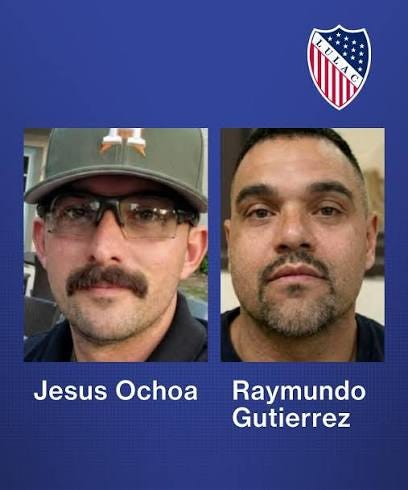
For a week, the government refused to name the agents who fired, withholding their identities even from Congress and from Minnesota law enforcement. When ProPublica identified them from government records, the names made my heart sink and landed with a blow to our community: Jesus Ochoa, a Border Patrol agent. Raymundo Gutierrez, a Customs and Border Protection officer.
Ochoa. Gutierrez. Names that could belong to any of our brothers, cousins, nuestro compadre, our neighbors.
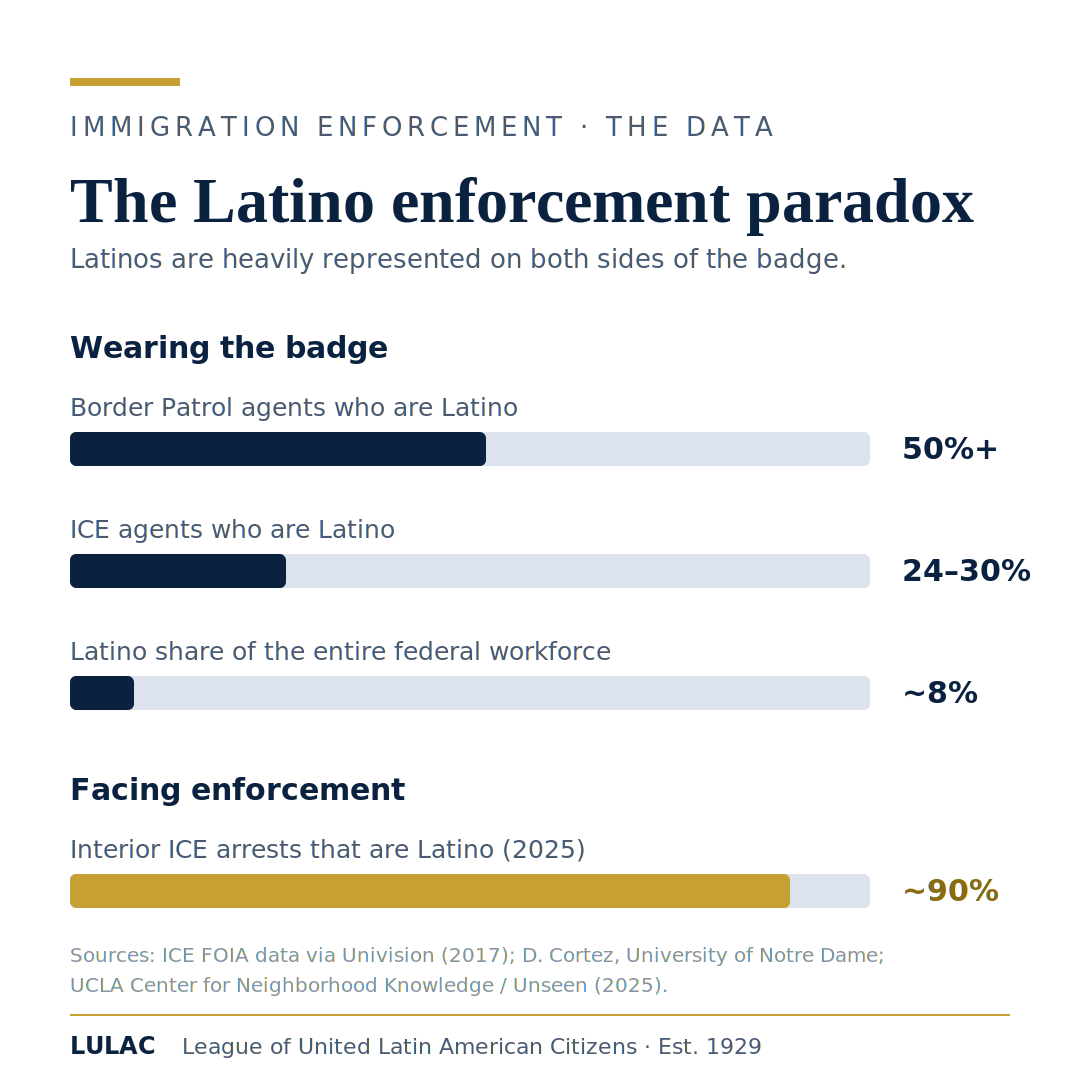
This is the dichotomy tearing at the Latino community in America today. The most recent publicly available data show that roughly a quarter of ICE agents, and more than half of all Border Patrol agents, are Latino. Data ICE itself released under the Freedom of Information Act show Latino ICE agents outnumber Black agents two to one and Asian agents four to one. In some border cities, Latino representation runs far higher still: in El Paso, nearly eight in ten ICE employees have been Latino. Latinos are about eight percent of the federal workforce overall, yet we fill the ranks of the very agencies now tearing through our neighborhoods, agencies this administration has quickly expanded from roughly 10,000 officers and agents to 22,000 in a single year.
Professor David Cortez at Notre Dame spent years interviewing more than a hundred Latino ICE and Border Patrol agents, and what he found was not self-hatred and it was not ideology. It was economics. One agent told him he joined because he was, in his words, literally starving. In communities where poverty is generational and opportunity is scarce, a federal badge has meant a stable salary, health care for your kids, and a pension, the same economic stability Lorenzo Salgado Araujo was chasing with a hammer and a work van. Two men got up before dawn on July 7 to provide for their families. Only one of them came home that night.
For decades, that bargain was tolerable because the job was, at least on paper, about public safety. Under this administration, the job has changed. And every Latino man and woman wearing that uniform knows it.
The Numbers Do Not Lie: Latino Men Are The Target
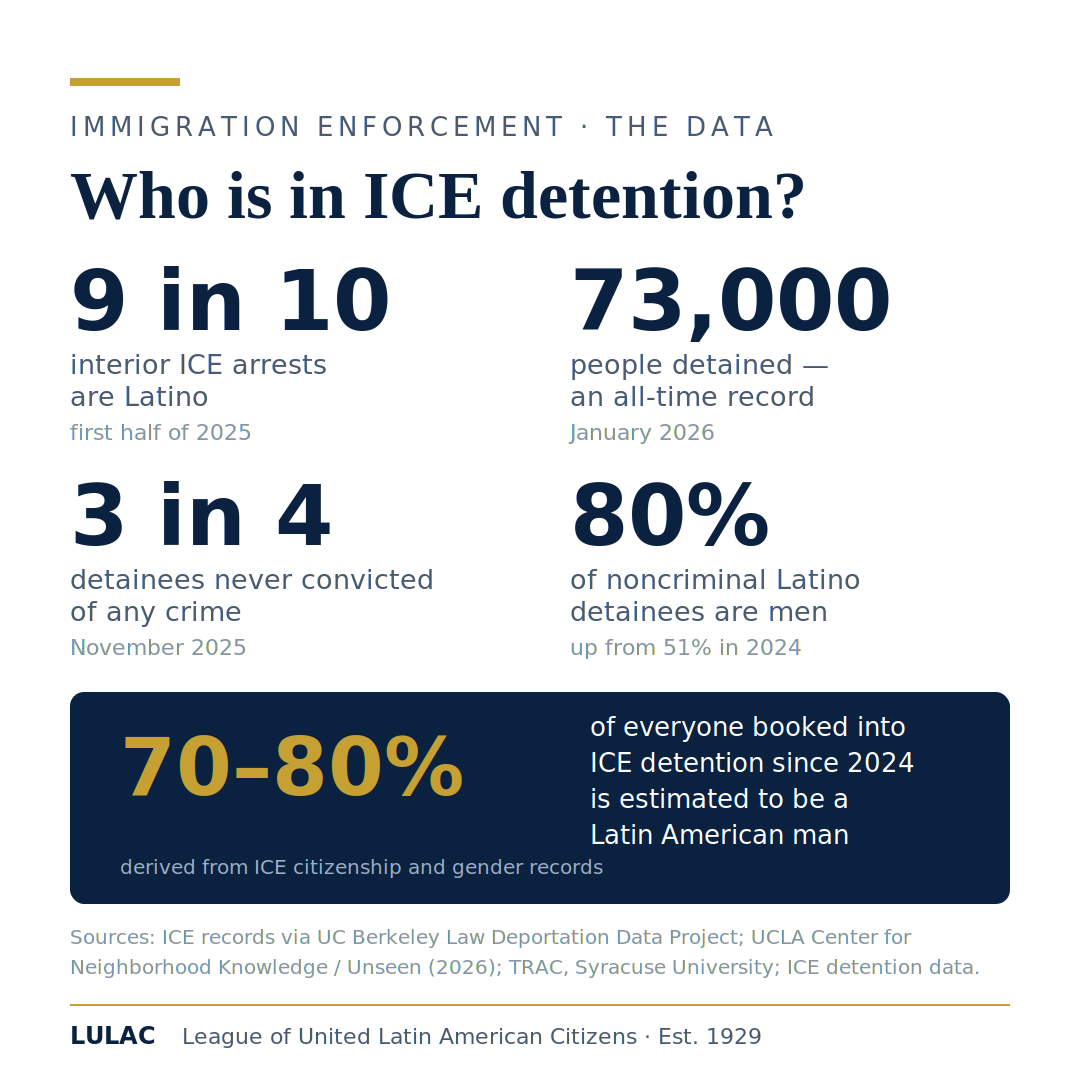
I want to be precise here, because this administration counts on us being imprecise. The data below come from ICE’s own records, case-level government files obtained by UC Berkeley Law’s Deportation Data Project and analyzed by the UCLA Center for Neighborhood Knowledge and the Unseen initiative. This is not rhetoric. This is the government’s own paperwork.
Latinos accounted for roughly nine out of every ten interior ICE arrests in the first half of 2025. Compare the first eight months of this administration to the same months of the last one, and the machinery comes into focus:
The number of noncriminal Latinos, people with no conviction and no pending charge, classified by ICE itself as mere “immigration violators”, entering detention each month went from about 900 under President Biden to about 6,000 under President Trump. The number of working-age Latino men in detention exploded from 3,500 to more than 38,700, an elevenfold increase. Men went from 51 percent of noncriminal Latino detainees to 80 percent. The share transferred out of state, away from their families and their lawyers, tripled from 18 percent to 55 percent. And the share deported upon release rose from 57 percent to 88 percent, while releases back to the community collapsed from 42 percent to just 9 percent.
Look at who these men are, and what happens to them. Detained noncriminal Latinos came from 19 countries, but three quarters came from just five: Mexico (27 percent of the total), Guatemala (17 percent), Honduras, Venezuela, and Ecuador. Detentions of Mexicans and Guatemalans rose nearly eightfold in a single year; detentions of Venezuelans rose fourteenfold. Daily Latino arrests doubled from 276 under the prior administration to 558 during this administration’s first hundred days, then climbed to 785 a day once the White House imposed its quota of 3,000 arrests. And once inside, they stay longer making private sector contracts like Geo Group billions of dollars and are shipped farther: the median detention stay stretched from one to three days to more than 25, nearly seven in ten noncriminal Latino detainees are now held for 15 days or more, and the typical stay now involves three separate facility placements instead of one, each transfer pulling a man farther from his family and his lawyer, and burning through tens of billions of dollars of tax-payer money.
Step back and look at the whole system. ICE’s detention population hit roughly 73,000 in January, the highest in American history, an 84 percent increase in a single year. Roughly three out of four people in that system have never been convicted of any crime, by mid-November, that was 47,964 human beings out of 65,135 in custody. Only about 5 percent of those booked into ICE custody this fiscal year have a violent conviction. The Washington Post’s analysis of the government’s own data found that nine of every ten people removed since January 2025 are men, consistent with ICE’s own historical reporting, which showed men making up 85 to 94 percent of detainees before the agency stopped publishing gender breakdowns last year to hide this information from you and me. Put the citizenship and gender records together and the conclusion is unavoidable: an estimated 70 to 80 percent of everyone booked into ICE detention since 2024 is a Latin American man.
They said they would go after the worst of the worst. They went after the men on the 6 a.m. shift.
And the deaths are mounting. Lorenzo’s killing is at least the eighth during this administration’s enforcement campaign. Last year was the deadliest year in ICE custody in more than two decades. The government of Mexico reports that seventeen of its nationals have died in ICE custody or enforcement operations. Renée Nicole Good. Alex Pretti. Silverio Villegas González. Ruben Ray Martinez. And now Lorenzo Salgado Araujo. Latino men are being targeted, hunted, and killed in our streets, and it is time to say so plainly, and time for it to stop.
A Weaponized Agency, Recruiting From Our Own Ranks
None of this is an accident. Congress handed this administration $170 billion for immigration and border enforcement, more than the annual budgets of every state and local police department in America combined. Seventy-five billion tax-payer dollars of it flows to ICE alone, on top of its base budget, with nearly $30 billion earmarked for hiring and enforcement operations. ICE is now the highest-funded law enforcement agency in the federal government, with a budget larger than the FBI, DEA, and ATF combined.
That money is buying a hiring spree unlike anything in federal law enforcement history: $50,000 signing bonuses, salaries up to $90,000, student loan repayment up to $60,000. DHS boasts that ICE has more than doubled its force, adding over 12,000 officers and agents in a matter of months, while watchdogs warn that hiring standards, screening, and training have been gutted to hit the numbers. And history tells us exactly where many of those recruits will come from: the same Latino communities these agencies have always drawn from, where a federal paycheck is the surest path out of poverty and Spanish fluency is prized in the field. The agency profits twice, first from our labor, then from our pain.
So a generation of Latino agents who signed up for a career, a pension, and a way to provide now find themselves ordered to run down men like Lorenzo at dawn. Masked. In unmarked cars. Without body cameras. Under arrest quotas of 3,000 a day set by Stephen Miller and White House officials. This is the clash of values our community has never before faced at this scale: fathers arresting fathers, Latino agents deporting men who could be an uncle or tío.
To the Latino ICE Agents Wearing the B adge
I am not writing to tell you to abandon your livelihoods. I am writing to tell you that history is watching what you do with them.
You know the difference between an enforcement operation and a hunt. You know the man in the work van with the ladders on top is not a cartel boss. You know that when a supervisor tells you numbers matter more than names, something has gone deeply wrong. And you know, better than anyone in America, what it does to a family when the man who left before dawn never comes home.
So I am asking you, directly: de-escalate. In every confrontation, at every traffic stop, at every workplace, be the officer who slows it down, who identifies himself, who holsters the weapon, who calls the ambulance first. Refuse the mask. Demand your body camera. Document what you see. Report what is unlawful. This moment calls for acts of moral objection from the agents themselves, from those who know better. There is no pension worth a man’s life. There is no signing bonus worth becoming the reason a wife in Magnolia Park is inconsolable and three sons are burying their father.
Your oath is to the Constitution, not to a quota, not to an administration, not to a talking point. Due process, the presumption of innocence, the sanctity of life: these are not obstacles to your job. They are your job.
This administration will not protect. There will be no pardon for you, those are only for the rich and powerful. You might receive protection temporarily, but when the law arm of the law comes, justice and accountability will deny you the freedoms you take from another man.
What We Demand
LULAC was founded in 1929 by Latino veterans who came home from serving this country to find themselves treated as strangers in it. For nearly a century we have answered moments like this one with organization, with law, and with our vote. We will do so again, in greater numbers than ever before. We are working on that to. We are counting on it.
We demand a fully independent investigation into the killing of Lorenzo, with the evidence, including his van, released to the Harris County District Attorney. We demand the names of the agents involved, as basic accountability requires in every American police department. We demand body cameras on every immigration officer in the field now, not in 60 days. We demand an end to masked, unmarked, quota-driven enforcement in our neighborhoods. And we demand that Congress, which wrote the $170 billion check, exercise the oversight that check requires.
Lorenzo built hundreds of homes in the country he loved for 35 years. On the morning he was killed, he was doing what Latino men across America do every single day before the sun rises: going to work to provide for the people he loved. If this administration cannot tell the difference between that man and a threat, then the threat is not in the work van.
It is time to stop. It is time for accountability. And it is time for every Latino in this country, including the ones wearing the badge, to decide which side of history they are standing on.
Sources
ICE detention and arrest records via UC Berkeley Law's Deportation Data Project; UCLA Center for Neighborhood Knowledge / Unseen, "Latino ICE Arrests Surge Under Trump" (Oct. 2025) and "Latino ICE Detentions Dramatically Reshaped Under Trump" (Jan. 2026); TRAC, Syracuse University; Cato Institute analysis of ICE book-in data (Nov. 2025); ICE FOIA data via Univision (2017); Washington Post analysis of ICE removal data (May 2026); ProPublica (Feb. 2026); Harris County Medical Examiner ruling; Hennepin County Medical Examiner ruling; American Immigration Council and Brennan Center for Justice analyses of H.R. 1; D. Cortez, University of Notre Dame, Political Research Quarterly; reporting by CNN, AP via PBS NewsHour, Houston Public Media, and NPR.
Thank you, Juan, for your tireless advocacy and prosecution of conspiracy.